
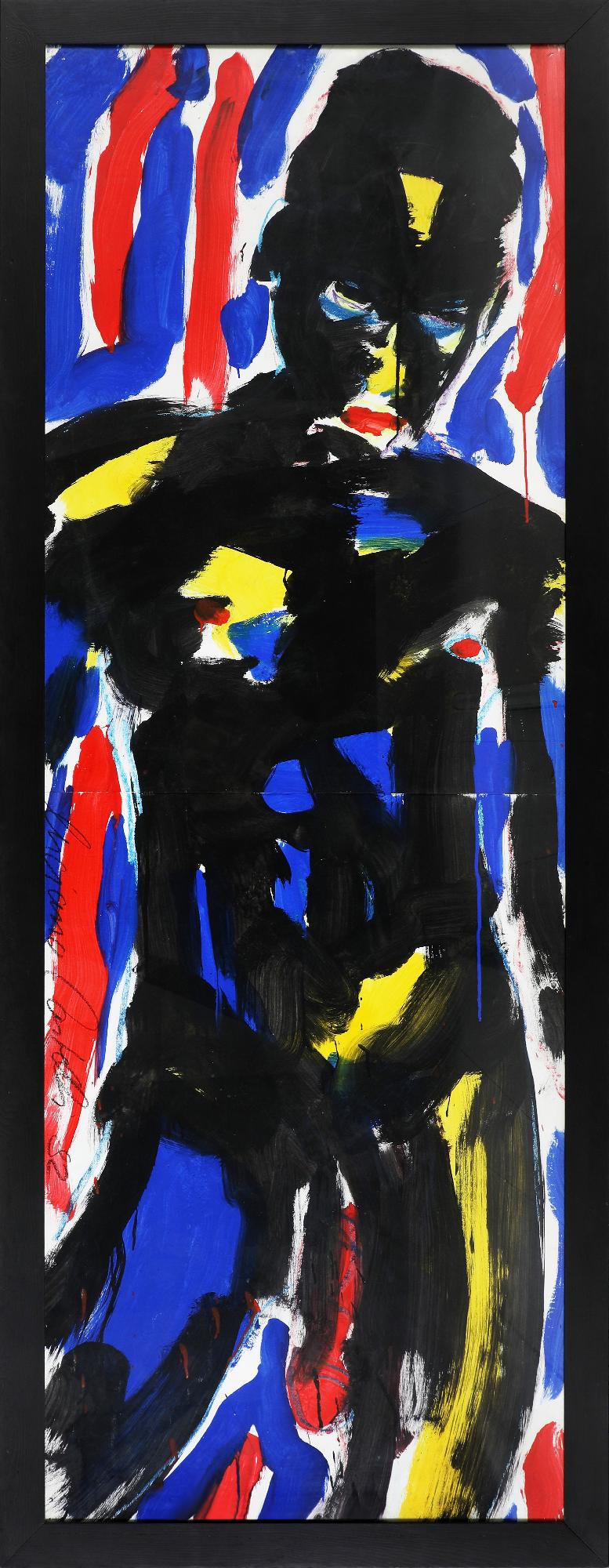
Männlicher Akt, 1982
Luciano Castelli
Pigmente auf Papier
signiert und datiert
Größe: 195 x 67,5 cm
Rahmen: 207 x 80,5 cm
Künstlerbiografie
Luciano Castelli
Luciano Castelli was born on September 28, 1951, in Lucerne. His inclination toward art initially led him to the art school in his hometown: in the preliminary course, he received instruction from the surrealist painter Max von Moos, after which he trained as a sign painter. In the 1970s, he made headlines with his notorious shared apartment. Luciano Castelli behaved like a bohemian, staging himself in a wide variety of roles in front of the camera. He was a man, a woman, and neither, throwing himself into glamorous costumes and becoming a fantastic fairy-tale character. The photorealistic paintings created by Swiss painter and graphic artist Franz Gertsch based on some of these wild snapshots gained great renown within the art scene. The most famous of these works is the group portrait Medici, which shows Castelli surrounded by his admirers and played an important role in Documenta 5, curated by Harald Szeemann in 1972. Luciano Castelli had already been able to show his first solo exhibition the year before. After his first performance, Solarium, which he performed at the De Appel gallery in Amsterdam, Luciano Castelli undertook a study trip to Austria and the USA. In 1973, he received the Swiss Federal Art Scholarship, which supported his further development. Castelli owed particular support to the Swiss art historian Jean-Christophe Ammann, who not only introduced him to Documenta curator Szeemann, but also gave Castelli's work a tremendous boost by organizing the highly acclaimed exhibition Transformer – Aspekte der Travestie (Transformer – Aspects of Travesty). The androgynous photos by Castelli that Ammann presented as part of this exhibition made the young artist famous. During this exhibition, Castelli met the surrealist photo artist Pierre Molinier, with whom he subsequently collaborated fruitfully. In 1976, Luciano Castelli created several illustrations for Alice's Smile by William S. Burroughs. After spending almost a year in Rome, he moved to Berlin in 1978, where he met the German painters Rainer Fetting and Salomé. Luciano Castelli experienced an unprecedented blossoming within the circle of Berlin's Neue Wilde (New Wild Ones). He painted collaborative pictures with Rainer Fetting and Salomé, and with the latter he also founded the avant-garde punk band Geile Tiere (Horny Animals), in which Castelli sang and played bass. The band gained some notoriety with several flamboyant performances at the Berlin club Dschungel. In 1989, Luciano Castelli moved to Paris, where two years later he married his muse Alexandra, who often became the subject of his paintings. His enthusiasm for playing with perspective led to intensive experiments with a homemade camera obscura. It was in this context that he created the so-called Revolver Paintings—paintings that have no predefined orientation and can be rotated in all directions, constantly revealing new relationships and connections. Luciano Castelli now lives and works alternately in Zurich, Paris, and Normandy.
